
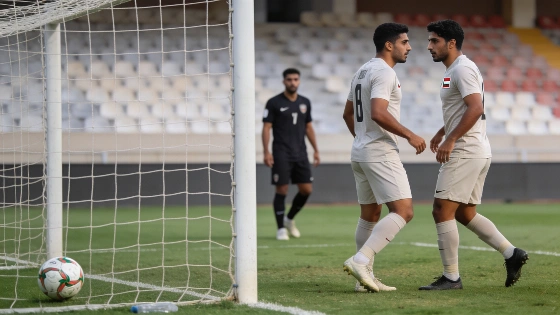
Nicolás Giménez opened the scoring in the 26th minute as the UAE beat Yemen 4-0 in Jeddah at خليجي 27. The win put the White team top of Group B on goal difference. Gulf News reported that the UAE and Qatar were level on points after both won their openers. The scoreline was clear. The UAE turned a cautious start into sustained pressure and attacks from several routes.
Gulf Cup 27 was staged in Jeddah from 23 September to 6 October 2026. Eight teams were split into two groups, with the top two in each group advancing to the semi-finals.
Control after a cautious start
Football analyst Musa Abbas called the UAE the strongest side in both performance and result during round one. He said the team played cautiously for the first 13 minutes. Then it took the initiative, moved the ball between the lines and pressed forward. Giménez's two goals stood out. Abbas also pointed to movement off the ball and the work of players such as Bruno, Alaa Al-Din Zuhair and Miloni. The attack did not rely on one player.
Sudanese analyst Bishara Abdel Nadhif also praised the links between the UAE's defence, midfield and attack. He said Yemen had capable players, but the experience gap and the UAE's level made it hard for the visitors to use their chances.
The UAE's next group match was scheduled against Bahrain on Sunday, 27 September 2026. A win would secure a place in the semi-finals regardless of the final group match against Qatar.
Coach Zlatko Dalić was appointed before the domestic league began, so he had a chance to watch players in action. He saw them across five league matches before the Gulf Cup. Before the tournament, he said he wanted a winning start in his first match in charge. Gulf Today also reported that the team prepared through domestic league matches. Abbas credited that preparation, the players' familiarity with their usual positions and the competitive rhythm of league and Asian club fixtures for the team's cohesion.
The site's wider UAE football coverage has also looked at change at club level through Dahoud's Dubai United move. In Jeddah, the national team's opening performance put the focus on results and tournament execution.
Group standings and the opening-round picture
Teams scored nine goals across four matches, an average of 2.25 per game. Saudi Arabia lead Group A with three points after a 1-0 win over Kuwait. Iraq and Oman have one point each after drawing 1-1. Kuwait are bottom without a point.
Saudi Arabia had to wait until the 73rd minute for the winner. Hamam Al-Hamami's effort inside the area went into the net off Kuwait's Youssef Al-Haqan. Iraq took the lead against Oman through Mohammed Qasim, then Nasser Al-Rawahi equalised. Iraq were stronger before the break. Oman improved after half-time.
Analyst Tarek El-Sayed said Iraq had not reached the level he expected. He added that the early-season timing may have affected the players' physical and technical readiness. Former Saudi international Hamad Al-Dubai called the overall standard moderate. He said Saudi Arabia and the UAE looked strongest technically, while noting that the Emirati defence had not faced a demanding test.
Saudi Arabia led possession at 67%, followed by the UAE at 61%, Bahrain at 59% and Iraq at 56%. The UAE and Qatar each had 12 shots. Saudi Arabia led with 23, followed by Iraq with 15. Round one also produced 11 yellow cards and two red cards. Qatar's Ahmed Fathi and Bahrain's Abbas Fadel Al-Asfour received the red cards.
Round two will test the early leaders
Giménez leads the scoring chart with two goals. Five players have scored once: Iraq's Mohammed Qasim, Oman's Nasser Al-Rawahi, UAE teammate Luan Pereira, and Qatar's Hassan Al-Haydos and Boualem Khoukhi.
Abbas called the UAE the early benchmark, but one round cannot decide the tournament. The next fixtures bring tougher tests, including Bahrain against the UAE and Kuwait against Iraq. Those matches will show whether the UAE's attack can keep its edge against opponents who offer more than Yemen did.
The UAE have the strongest position after round one, built on a four-goal win, several attacking threats and a lead on goal difference. They are the team to beat on the evidence so far, not confirmed champions. The defence remains the main question after an otherwise commanding start.