
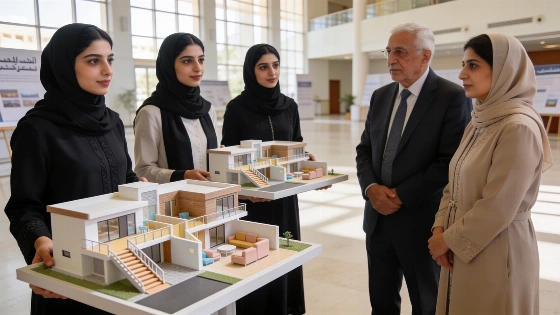
Accessible design in the UAE took a real step forward as three student teams from the University of Sharjah's College of Fine Arts won top awards for their villa interiors. Each project was built around the needs of people with disabilities. The winners were chosen from more than 15 entries and honoured at a ceremony in Sharjah. For many, it was a rare moment where inclusion and technical skill came together in the country's design education.
Each winning villa tackled a different challenge. One was designed for people with mobility impairments. Another focused on hearing disabilities. The third was made for people with autism spectrum disorder. The students didn't just add a few features-they rethought the whole space. Their interiors had wide, open areas, furniture arranged for easy movement, and rounded, soft-edged pieces to cut out sharp hazards. These were real, practical changes, not just surface-level gestures.
The competition required students to design villa interiors specifically for wheelchair users and people with hearing impairments, applying international accessibility standards and innovative materials.
For people with hearing impairments, the students swapped out audio alerts for visual cues. They built in lighting and visual signals to help with safety and communication. They made the most of natural light and picked artificial lighting for comfort. Non-slip floors, carefully built ramps, and lifts that meet the World Disabled Union's code were all standard features.
At the ceremony, the student designers explained why they made each choice. Their presentations showed a level of technical and empathetic thinking that is still rare in most architecture schools. Dr. Tarek Sultan bin Khadem, Vice President of the World Disabled Union, and Professor Nadia Mahdi Al Hussein, Director of the University of Sharjah College of Fine Arts, handed out the awards in person. The Secretary General of the World Disabled Union was also there, showing how much weight the organisation put behind the event.
Professor Nadia Mahdi Al Hussein thanked the World Disabled Union for organising the competition and building a strong partnership. Dr. Tarek Sultan bin Khadem said the collaboration would continue. He called it a strategic effort to connect universities and advocacy groups, and to help future generations serve their communities with a real commitment to inclusion and justice.
According to Sharjah24, the initiative was conceived as a way to promote inclusive design and raise awareness about accessibility in the built environment. Dr Iman Ibrahim, the competition coordinator, highlighted that participants not only adhered to international accessibility standards but also incorporated innovative techniques and materials, reflecting a high standard of quality in the submitted projects.
This focus on celebrating the work of Emirati pioneers in sport and community service matches the approach seen in recent coverage of Sultan Saqr Al Suwaidi's legacy. It shows how important institutional memory and recognition are in shaping the UAE's social landscape.
What made this competition different was its demand for real, practical standards. Students were rewarded for solutions that could work in actual homes, not just for abstract ideas. The message is clear: the future of design in the UAE will be measured by how well it delivers true accessibility-not just in public statements, but in the daily lives of residents. The University of Sharjah and the World Disabled Union have set a standard. If the country wants to put inclusion at the heart of its built environment, other institutions will need to follow their lead.