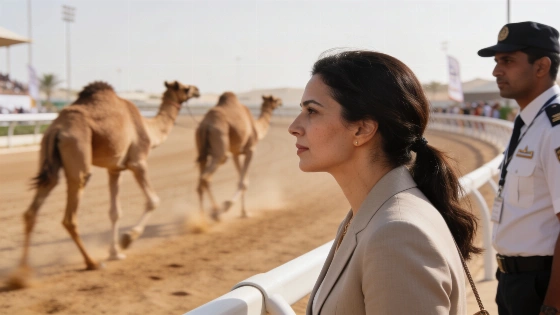
At Al Rawda track in Al Ain, the festival's closing programme ran from October 3 to 8, 2026. Sheikh Hazza bin Zayed Al Nahyan was patron of the event, Emirates News Agency (WAM) reported. US Senator Joni Ernst watched the heritage race during the festival's final programme.
The festival's final programme comprised 150 races: 10 heritage races, 42 Haqayeq races, 32 Laqaya races, and 22 each in Itha'a, Thanaya, Houl and Zomool.
A race rooted in Emirati heritage
Abdullah Mubarak Al Muhairi, head of the Abu Dhabi Heritage Authority and Director General of the Camel Racing Federation, welcomed Ernst and showed her around the festival. She watched the heritage race and learned about camel racing's place in the country's history and culture. Festivals can help pass the tradition on to younger generations. WAM reported that the Presidential Camels and Camel Racing Affairs Centre organised the festival under the supervision of the Camel Racing Association. After the traditional races, the programme moved through the Haqayeq, Laqaya, Itha'a, Thanaya, Houl and Zomool categories.
Romooz participants were required to have their camels inspected and their ages checked between 06:00 and 07:00. Category checks took place in stages from October 2 to 6, according to the schedule for each age group.
Competition and cultural continuity
The festival brings sporting contests together with a public display of Emirati heritage. Ernst's attendance brought an international visitor to the event. The races showed its sporting side, with competitors facing one another across multiple heats in a tradition closely tied to local culture.
In a 3-kilometre Haqayeq race, Thiqah recorded a winning time of 4:18.50. Al Khaleej reported that Numas, owned by Ahmed Sultan Bal-Rashid Al Suwaidi, won an open race in 4:22.27.
The festival keeps camel racing visible and gives the tradition a place in the present-day event calendar. The competition matters, too.